
Welcome to Ramgarhia Sabha Reading
Gurdwara & Sikh Centre Serving the Reading Community
Registered Charity No 1197912
Bookings
Opening Times
Wednesdays:
12:00 – 20:00
Sundays:
09:00 – 14:00

About Us
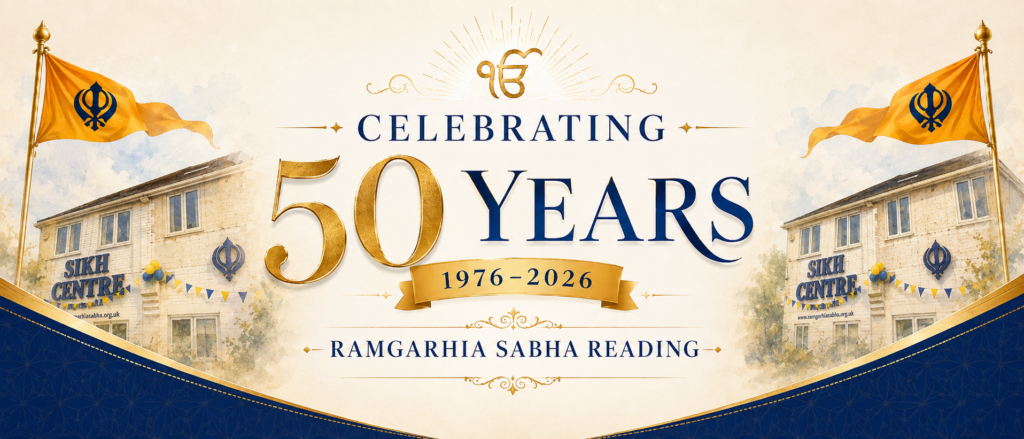
Ramgarhia Sabha Reading is a charitable organisation first registered in 1976. It has now grown in to a very busy Gurdwara and a community resource centre.
About Our Charity
Ramgarhia Sabha Reading (RSR) is CIO registered charity number 1197912 with Charity Commission. It can have up to 21 appointed Trustees and many additional Sevadars to manage its affairs and outreach community services.
RSR is a totally unpaid volunteer led organisation set up under the charity commission and related regulations. RSR complies with all such related legal and obligatory as well as voluntary regulations.

RSR operate full Sikh faith Gurdwara services for its community and members in accordance with the teachings of Sri Guru Granth Saheb Ji and the Sikh Rehat Maryada and guidance from related authorities such as Supreme Sikh Council UK (set up with permission from Akal Takht and supported by some 200+ UK Gurdwaras), Ramgarhia Council UK, NSO, and many such organisations.
RSR run several community projects and joint ventures along with volunteer led Sikh education programmes.
RSR works with and enjoys relationships with many authorities, such as the NHS, Gurdwaras, along with other organisations. RSR adheres with all trust laws and regulations.
Our Location
Directions
RSR Gurdwara Sahib is very easy to find. As you enter Reading coming off Junction 10 on the M4, take the 3rd exit on the A4 roundabout and we are approximately 100 meters on your right.
Introduction to Sikhism
Sikhism is a monotheistic faith that originated in the Punjab region of South Asia during the 15th century. It was founded by Guru Nanak Dev Ji, whose teachings were carried forward and developed by nine successive Sikh Gurus. In 1708, the Tenth Guru, Sri Guru Gobind Singh Ji, bestowed eternal Guruship upon Sri Guru Granth Sahib Ji, making it the eternal spiritual guide of the Sikh faith.
In 1699, Guru Gobind Singh Ji established the Khalsa and initiated the first five Sikhs, known as the Panj Pyare (the Five Beloved Ones). He then asked them to initiate him into the Khalsa, demonstrating equality within the Sikh community. Members of the Khalsa adopted the surnames Singh, meaning “lion”, for men and Kaur, meaning “princess”, for women, and committed to maintaining the Five Ks, the articles of faith worn or carried by initiated Sikhs.
At the heart of Sikhism is the belief in one God, known as Ik Onkar or Waheguru, who is formless, eternal and present throughout creation. Sikhs seek a direct and personal relationship with God through prayer, meditation, honest living and adherence to the teachings contained in Sri Guru Granth Sahib Ji.
Sikhism emphasises equality, justice and selfless service. It rejects discrimination based on caste, gender, social status or background, as well as the practice of idol worship and empty rituals. Sikhs are encouraged to earn an honest living, share with those in need, and treat all people with dignity and respect.
The Guru Granth Sahib Ji holds the highest place of honour in every Gurdwara (Sikh place of worship) and is respectfully placed on a raised throne, reflecting its status as the eternal Guru. Congregations gather in Gurdwaras to pray, listen to the recitation of hymns and participate in communal worship.
Distinctive features of the Sikh faith include uncut hair (Kesh), often covered by a turban, and the Five Ks: Kesh (uncut hair), Kangha (wooden comb), Kara (steel bracelet), Kachera (special shorts) and Kirpan (ceremonial sword).
A central Sikh principle is Sarbat da Bhala, meaning “the welfare of all”. This reflects the commitment to serving humanity, promoting social justice and contributing positively to society through voluntary service, charitable acts and support for those in need.